

Dear brothers and sisters, the readings invite us to reflect on what it means for a Christian to have faith in God. In the first reading, the prophet Habakkuk cries out to God because of violence, injustice, and strife all around him. He laments to God, “Why do you let evil happen? Why do you remain silent in the face of corruption?” (Hab 1:2-3). He voices the tension between faith in a just God and the harsh reality of corruption and violence. The question of Habakkuk is the question of many of us today: why do bad things happen to ‘good people’? Honest workers lose their jobs, families are torn apart by war, innocent children die, and faithful believers suffer from sickness. Meanwhile, bad things happen to ‘bad people’: corrupt leaders grow rich, oppressors gain power, and liars succeed. Like the prophet, many today cry out, “God, where are you? Why do you stay silent? Why do you stay silent about my situation?” The first reading tells us that God’s answer is that of faithful trust: “The righteous shall live by faith” (Hab 2:4). Faithful trust that God’s justice operates on a different timeline. As God replies, “If it seems slow, wait for it; it will surely come, it will not delay” (Hab 2:3).
However, it can be difficult and challenging to keep the flame of faith burning amidst all that is happening around us—in our families and in our lives. The only thing we can do is to cry out, as the apostles did in today’s Gospel: Lord, “increase our faith.” In the Gospel of Luke 17:5-10, we encounter the troubled hearts of the apostles, who, after listening to Jesus’ previous teachings, are left with a sense of emptiness. After Jesus emphasized the inevitability of encountering offenses in life, he underscored the importance of personal responsibility in managing interpersonal conflicts, advising that if a brother sins, he should be rebuked and if he repents, he should be forgiven as many times within a single day. The disciples, recognizing the difficulty of such demands, request increased faith to meet these spiritual challenges.
From Jesus’ response, we need to correct some misconceptions about faith: that it involves quantity, extraordinary powers that defy natural limits or invert natural order, emotional attachment or feelings, or motivation. In the subsequent reading Luke 17:11-19, after healing the ten lepers and only one returning to thank Christ, Jesus said to him, “Your faith has saved you.” The same is true for the centurion, whom Jesus commended for having “great faith” (Matthew 8:10). Jesus also asked the disciples, “Why are you so afraid? Do you still have no faith?” after calming the storm (Mark 4:40). So,
what does it mean for a Christian to have faith in God? The second part of the Gospel provides a hint: being a servant. Being a servant in two ways: first, doing what is expected of us as Christians and allowing God to be God—trusting in His divine providence. It means total confidence in God in all situations. Second, it involves service to our brothers and sisters; service that is not motivated by personal interest or ego, but for God’s glory and the benefit of others.
The question we should ask ourselves is whether we are faithful to our Christian commitments, our moral conscience, and ourselves, for God is always faithful. As 2 Timothy 2:13 states, “If we are unfaithful, he remains faithful, for he cannot deny himself.” What is the purpose of our service to our brothers and sisters? Saint Paul, in today’s second reading, reminds us that the Spirit God gave us is not one of timidity but of power, love, and self-control. Let us ask God to increase our faith so that we may become faithful witnesses of His love in the world. Amen
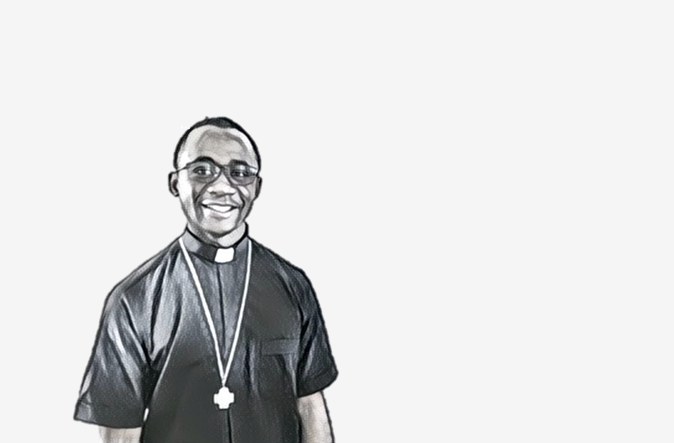
NGALA AUSTIN KANJO
Piarist
Ngala Austin Kanjo is a religious and priest in the Order of the Piarist Schools from the Province of Central Africa. Born in Shisong, Cameroon. He is currently undergoing a master’s program on formation of formators at the Gregorian University.