

Dear brothers and sisters, just after the Beatitudes that we heard last Sunday, Jesus continues His message by speaking about being the salt and light of the world. These two passages are deeply connected. The Beatitudes describe who a Christian is: poor in spirit, meek, merciful, peacemakers… They speak about the inner character and identity of a disciple of Christ. Today, Jesus moves from identity to impact. Notice something very important: Jesus does not say, “Try to be salt” or “Work hard to be light.” He says, “You are.” This means that if we truly live the Beatitudes, we cannot help but influence the world around us. This becomes a serious examination of conscience for us as Christians. Are we truly light? Are we just, loving, peaceful people? Sometimes, sadly, we Christians become agents of division, violence, unforgiveness, and injustice—within our families and in our workplaces.
Jesus chose salt and light very intentionally because they act by their nature, not by effort. Salt does not struggle to be salty. Light does not struggle to shine. In the same way, a Christian who lives the Beatitudes—who is poor in spirit, meek, merciful, and a peacemaker—does not need extraordinary actions or public preaching. Simply living differently, wherever he or she is, already makes an impact. Jesus’ teaching implies something radical: that the people who appear weak, meek, merciful, and even persecuted are actually the most powerful force in society. Not religious elites. Not politicians. Not warriors. But people formed by the Beatitudes. That is why, in the second reading, Saint Paul warns the Christians of Corinth. They admired wisdom, strength, and eloquence, and they were impressed by the eloquence of the preacher who came after Paul. Paul reminds them that their faith should not rest on human philosophy or eloquence, but on an encounter with the power of God. Being salt and light, coming to church, or living the Beatitudes is not simply a philosophy to follow or a set of commandments to obey. It is the fruit of our encounter with God and our living faith in Him.
In the first reading, Isaiah gives us very practical ways by which the world will recognize us as salt and light: sharing our bread with the hungry, sheltering the homeless, clothing the naked, removing oppression, aggression, and harmful speech. I would like us to meditate on just one of these: “not turning away from our own kin.” In other words, not closing ourselves to the suffering of those around us. We cannot claim to love God while being indifferent to the concrete person next to us. And this indifference is not only toward others, but even toward us. We become indifferent to whether we sin or not. Indifferent to whether we lie or not. Indifferent to whether we go to confession or receive Holy Communion. This indifference slowly darkens the light within us. Isaiah says that when we begin to care about these small aspects of our life and the lives of others, our wounds will be healed, our integrity will go before us, and the glory of the Lord will follow us. As the psalmist says today: “A good person is a light in the darkness for the upright.” Let us pray for the grace to be light ourselves first, so that we may truly become light for others.
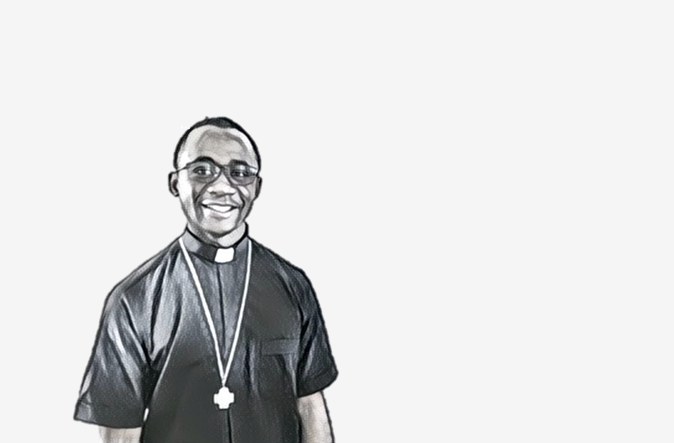
NGALA AUSTIN KANJO
Piarist
Ngala Austin Kanjo is a religious and priest in the Order of the Piarist Schools from the Province of Central Africa. Born in Shisong, Cameroon. He is currently undergoing a master’s program on formation of formators at the Gregorian University.