

Dear brothers and sisters, as we celebrate the Baptism of our Lord, I invite you to meditate on Jesus’ words: “Allow it now, for thus it is fitting for us to fulfill all righteousness.” At the beginning of his public ministry, according to the Gospel of Matthew, Jesus chooses to be baptized by John the Baptist. John, who had preached the coming of Christ, felt unworthy to baptize his Savior. We might ask ourselves: if John’s baptism was a baptism of repentance, did our Lord need to repent of any sin? Jesus’ response helps us understand the deeper meaning of this moment: “Leave it like this for the time being; it is fitting that we should, in this way, fulfill all righteousness.” The baptism of Jesus has nothing to do with repentance from sin. Rather, Matthew shows us that baptism is no longer only a call to repentance; instead, Jesus himself becomes the very center of baptism. Baptism becomes the path by which a right relationship with Christ is established.
Through repentance and baptism, we are set on the path of righteousness and incorporated into a community of which Christ is the head. As Saint Paul tells us in the Letter to the Colossians, in Christ we have redemption and the forgiveness of sins. The day of our baptism was a day of redemption, a day when we were incorporated into the community where Christ reigns as head. Do we remember this special day of our baptism? Do we remember the commitments that were made? How has our relationship with Christ grown since then?
After Jesus was baptized, he came up from the water, and suddenly the heavens opened. He saw the Spirit of God descending like a dove and coming to rest upon him. While the Gospel of Mark speaks simply of “the Spirit,” and Luke of “the Holy Spirit,” Matthew deliberately uses the phrase “the Spirit of God,” emphasizing Jesus as the Son of God in whom the Father is well pleased. Matthew helps us see that Jesus is the chosen servant spoken of by the prophet Isaiah in the first reading. The image of the dove and the words spoken by the Father directly connect with that prophecy: “This is my beloved Son, in whom I am well pleased.” Christ is the servant, the chosen one in whom God delights.
This servant will bring justice, open the eyes of the blind, and free captives from prison, as we hear in the first reading. Christ not only forgives our sins; he frees us from fear and sorrow, no matter our present situation. This message of redemption and grace is meant for everyone. Saint Luke makes this clear in the second reading when Peter says to Cornelius: “I have come to realize that God shows no partiality, but in every nation anyone who fears him and does what is right is acceptable to him.” To fear God does not mean to be afraid of him or distant from him; rather, it means recognizing God’s presence in our lives. The question we must ask ourselves is this: in our daily actions and behavior, are we conscious of God’s presence? Do we strive to do what is right in his sight? The psalmist tells us that the Lord blesses his people with peace. Let us pray that God may pour this peace into our hearts, our families, and our lives.
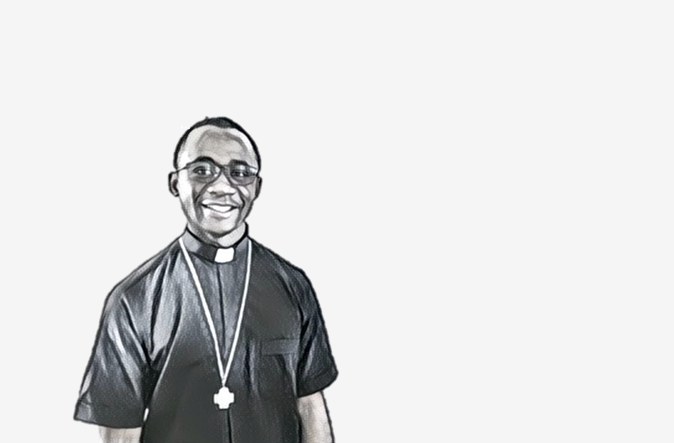
NGALA AUSTIN KANJO
Piarist
Ngala Austin Kanjo is a religious and priest in the Order of the Piarist Schools from the Province of Central Africa. Born in Shisong, Cameroon. He is currently undergoing a master’s program on formation of formators at the Gregorian University.