

Dear brothers and sisters in Christ, Last Sunday, we reflected on the importance of persevering in prayer. Today, the Church invites us to go a step further and meditate on the theme: “Who Is at the Center of My Prayer?”
In the Gospel, Jesus presents us with two figures who go up to the temple to pray: a Pharisee and a tax collector. Both take part in a most fundamental act of faith; prayer, yet their disposition make all the difference. Through them, Jesus teaches us what kind of prayer truly makes us righteous before God. The Pharisee’s prayer is filled with self-glorification. He stands before God boasting of his moral and ritual observance: “I am not greedy, dishonest, or adulterous.” He fasts; he tithes but his heart is full of himself. The Gospel even tells us that he “prayed to himself,” meaning his prayer was not truly directed to God, but to his own ego. His words begin with justification and comparison: “I am not like the rest of men…” The Pharisee has removed God from the center and placed himself there instead. In contrast, the tax collector stands at a distance. He cannot even lift his eyes to heaven. Beating his breast, he humbly says, “God, be merciful to me, a sinner.” His prayer is simple, sincere, and born from the depths of his heart. It does not begin with his achievements but with his need for mercy.
Dear brothers and sisters, how often do we too become like the Pharisee! We measure our Christian life only by external actions, how well we observe the rules, how often we go to church, how many devotions we perform each day, and we start comparing ourselves to others. We judge, we criticize, we condemn. Even in prayer, we may end up talking more about ourselves than about God. But today, Jesus reminds us that true prayer is humble. It begins by recognizing that we are all sinners in need of mercy. Instead of condemning others, we are called to pray for them, entrusting all of us to the infinite compassion of God.
The first reading, from the Book of Sirach, tells us that the Lord is a God of justice who shows no partiality. He hears the cry of the oppressed, and the prayer of the humble “pierces the clouds.” Such a prayer rises directly to heaven because it carries no pride or self-sufficiency, unlike the prayer of the Pharisee, which never leaves the temple. Indeed, while the prayer of those who think themselves righteous remains earthbound, weighed down by the gravity of ego, the prayer of the humble heart rises freely to God.
So, dear brothers and sisters, let us ask ourselves today: What is the true content of our prayer? Who stands at the center, God or us? Are our prayers humble enough to pierce the clouds of heaven? As the Psalmist says, “The poor man called, and the Lord heard him.” May we remain poor and humble in our prayer, so that, at the end of our journey, we may be able to say with Saint Paul in the second reading: “I have fought the good fight, I have finished the race, I have kept the faith.” Through the intercession of the Blessed Virgin Mary, may we always pray with humility and sincerity of heart.
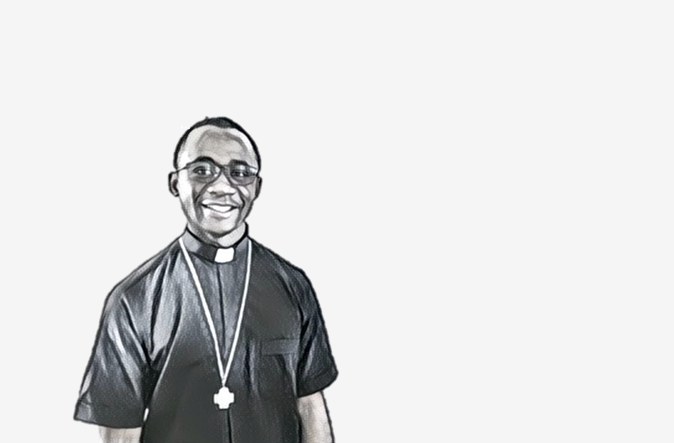
NGALA AUSTIN KANJO
Piarist
Ngala Austin Kanjo is a religious and priest in the Order of the Piarist Schools from the Province of Central Africa. Born in Shisong, Cameroon. He is currently undergoing a master’s program on formation of formators at the Gregorian University.